Showing posts with label technology. Show all posts

Saturday, February 02, 2008

Microsoft makes £22.4bn bid to take over internet giant Yahoo

Microsoft is planning to challenge the dominance of Google with a £22billion buy-out of rival internet search engine Yahoo.

The company set up by Bill Gates has made an offer for Yahoo in what would be one of the biggest internet deals in history.


Microsoft chairman Bill Gates. The company's bid for Yahoo signals an attempt to grab a bigger chunk of business in online services

But the offer has led to further concerns about the growing power of Microsoft, which makes gross profits of about £20billion and has fought allegtions of anti-competitive behaviour in courts on both sides of the Atlantic.

Late last year it bought a £120million stake in the online networking sensation Facebook. Many fear that if the Yahoo deal does go through the company really will wield too much power.

Among the criticisms levelled at the company is that it deliberately locks customers into its products.

This has led to complaints that computers cannot be bought without a Microsoft operating system being pre-installed.

Many fear that if Microsoft gets hold of Yahoo it will be able to increase its influence over internet usage.

Currently Microsoft and Yahoo's search engines trail a long way behind Google - in America 56.3 per cent of searches are carried out through Google. Yahoo is in second place with 17.7 per cent and Microsoft follows with 13.8 per cent.

Google, founded by Sergey Brin, left, and Larry Page, right, faces an assault by Microsoft billionaire Bill Gates

Google's success has been based on the perception that its searches are wider and more relevant than rivals.

Microsoft say it wants to create 'credible alternative' to the domination of Google.

But if any deal is agreed it could be subject to heavy scrutiny by regulators on both sides of the Atlantic.

This is because, as well as both operating powerful search engines, Microsoft and Yahoo are players in the wider online advertising market.

Liberal Democrat culture spokesman Don Foster has called for UK competition authorities to look at the deal.

"Everybody should be concerned about the growing dominance of Microsoft in every aspect of our lives," he said.

"While they have done much good for us, we have to be incredibly careful that they don't become so dominant that innovation and creativity is stifled."

He urged the Competition Commission to look into the deal, if it was able to.

Yahoo's headquarters in Sunnyvale, in California's Silicon Valley

In the early days of the internet, Yahoo, founded by two U.S. students, was the most popular search engine.

The engines work by picking out key words from every internet page which can be accessed by its network. The contents of each page are analysed and categorised on an database.

When someone enters a query into a search engine it will search its index and come up with the best matches.

While it has been losing out in recent years to Google, it is still widely used for emailing and its news services.

The two Americans behind Yahoo are likely to pocket £2.2billion if the deal goes through.

Jerry Yang, 39 and David Filo, 41, started Yahoo as a website listing board while students at Stanford University in California in 1995.

Originally called Jerry's Guide to the World Wide Web, Yang and Filo changed soon switched to Yahoo, named after a race of brutes in the Jonathan Swift novel Gulliver's Travels.

The unexpected offer comes as Yahoo and Microsoft have fallen behind Google in the race to capture online advertising.

Internet advertising is a massive growth industry and there are predictions that the online market will double in size to around £40.2billion by 2010.

The potential deal is so big that it boosted shares on the FTSE 100 index yesterday,

A Microsoft spokesman said: 'Today this market is increasingly dominated by one player.

"Together, Microsoft and Yahoo can offer a competitive choice while better fulfilling the needs of customers and partners."

Thursday, September 27, 2007

Scientists create the world's first see-through frog

Frogs come in nearly every colour of the rainbow - from the dull greens of British species, to the vivid yellows and reds of their tropical relatives.

But Japanese scientists have gone one step further than mother nature - and created a transparent frog.

The creature's see-through skin allows researchers to see details of its internal organs and blood vessels. They say this could bring huge benefits to medicine, making it easier and cheaper to study diseases such as cancer.


Professor Masayuki Sumida, who led the project at the Institute for Amphibian Biology at Hiroshima University, said scientists could look at the effect of drugs and chemicals on the frog's internal organs and blood vessels without the animals having to be killed and dissected.

'Because the frogs remain transparent from their birth to adulthood, organs of the same frog could be studied throughout,' he said. 'This is simple and cheap when studying, for instance, how certain chemicals influence bones.'

By attaching green fluorescent markers to a stretch of DNA and injecting it into the frog, researchers can also study the behaviour of genes in a living organism.

The transparent frog (pictured) is the offspring of common Japanese brown frogs. It was created through traditional selective breeding, rather than genetic modification, using wild frogs with a mutation that gives them pale skin.

By mating the palest frogs they could find and then breeding from their palest offspring the researchers were able to create the see-through strain.

The scientists say they plan to patent the technique but have yet to perfect the process. Only one in 16 frogs they breed has transparent skin and they have not succeeded in getting the transparent frogs to breed see-through offspring.

Most of the world's natural see-through creatures live underwater. Animals such as jellyfish, sea worms, sea snails and octopuses evolved transparency as a form of camouflage. In an environment where there are few hiding places, being see-through can give them an edge.

Thursday, September 20, 2007

Search startup ready to challenge Google

Barney Pell - President and CEO of Powerset, a new search engine that uses ‘natural-language’ technology to make Web search easier - hopes to demonstrate that Google isn’t as smart as most people think

There’s no business like search business. And this is precisely why a US-based start-up called Powerset is pursuing a particularly challenging goal: It’s aiming to outshine Internet’s search giants, Google, with its own new search software.

After nearly two years of hushed development, the San Francisco-based company is finally providing a peek at a “natural-language” technology that is supposed to make it easier to communicate with search engines.

The algorithms in Powerset are programmed to understand search requests submitted in plain English, a change from the “keyword” system used by Google, Yahoo, Microsoft and the owners of the other leading engines.

The distinction means Web surfers will theoretically be able to get more meaningful results by typing more precise search requests in the form of straightforward questions like “What did Steve Jobs say about Apple?” instead of entering an ungrammatical mishmash like “Apple Steve Jobs said.”

Barney Pell, Powerset’s co-founder and chief executive, likens the hit-and-miss-process of searching with keywords to talking to a 2-year-old.

“In one sense, you are happy you can talk to it at all, but you still really want it to grow up so you can hold a real conversation,” he said.

This isn’t the first time a search engine has tried to understand simple English, but Powerset has drawn more attention because its natural-language technology is being licensed from the Palo Alto Research Centre.

Better known as PARC, the Xerox Corp subsidiary is renowned for hatching breakthroughs – such as the computer mouse and the graphical interface for personal computers – that were later commercialised by other companies.

“We have the best natural-language search technology that has ever been developed,” Pell, an artificial intelligence expert, said.

Backed by $12.5 million in venture capital, Powerset is gradually opening its testing ground, dubbed Powerlabs, to 16,000 people who signed up to get an early glimpse at the search engine.

The start-up is so confident that its methods are superior to Google that Powerlabs will present some answers alongside what its rival returns when asked the same questions. Powerset is requiring its users to vote on which engine produced better results before they are allowed to enter another search request.

Search Antecedents

Other search engines have previously promised to understand conversational English with little success.

Ask Jeeves was founded in the 1990s on the premise that Internet search requests should be presented as simple questions. It frustrated users with too many irrelevant answers.

After nearly failing in the dot-com bust, the company embraced the keyword approach to search and abandoned its mascot – a cartoon butler named Jeeves – to distance itself from the days it relied on natural-language algorithms. It is now known simply as Ask.com.

Industry analyst Charlene Li of Forrester Research is sceptical about Powerset’s prospects, too. She doubts Powerset will be able to comprehend all the different ways that people seeking the same type of information can phrase their questions.

For instance, the questions “What caused the collapse of Enron?” and “What caused the downfall of Enron?” typically produce different search results even though they are essentially asking the same thing, Li said. That’s because computers have trouble recognising synonyms and other subtle nuances in language.

“Understanding the meaning of many words is difficult without people involved,” she said.

Thursday, August 23, 2007

First Olympic bullet trains arrive in Britain

The first of the 140mph Japanese bullet trains that will go into service on the UK rail network in 2009 arrived in Britain.

The six-car Hitachi Class 395 train reached Southampton on board a roll-on, roll-off ferry.

The bullet trains will be used by the Southeastern train company for domestic services on the soon-to-be-completed final section of the Channel Tunnel Rail link from Kent into central London.

The trains will also play a key role in 2012 London Olympics transport provision by taking spectators from St Pancras station in London to the Olympics site at Stratford, east London, in just seven minutes in a service to be known as the Olympic Javelin.


All aboard: The first of four bullet trains is unloaded at Southampton

St Pancras International station is due to open in November 2007.

Manufactured in Kasado, Japan by Hitachi, the train which arrived today is the first of four which will be delivered over the coming months.

The remaining 25 trains will arrive in 2009 in time for the start of the new services in December of that year.

Alistair Dormer, general manager at Hitachi Rail Systems London, said: "Hitachi is delighted to deliver the first Class 395 train to the UK, on time and on budget.

"Today is a major milestone for Hitachi and for everyone involved in the Class 395 project. We now look forward to working with our partners to complete testing and delivering the trains ready for service in 2009."

The new-look St Pancras station opens in November 2007

Southeastern managing director Charles Horton said: "The arrival of the first high-speed train into the UK is great news. When these trains enter service, they will slash journey times across the region, encourage more people to travel by train and bring new standards of comfort and reliability.

"They will also play a key role in providing fast and easy access to the London Olympic Games at Stratford in 2012, with a journey time to and from London St Pancras of just seven minutes. Our ambition to create a growing railway for a growing region has taken an important step forward."

Artist's impression of the new train in action

Recently, the Government announced that Hitachi UK was one of three organisations shortlisted to compete to build a new generation of express trains for the UK's rail network in a contract expected to be worth around £4 billion.

Hitachi Europe is up against Alstom-Barclays Rail Group and the Express Rail Alliance - a consortium involving four companies, including Bombardier and Angel Trains.

Fact box
1. Using both high-speed and existing lines, journeys to St Pancras will be slashed after two years of trials from 83 to 37 minutes from Ashford, 102 to 61 minutes from Canterbury, and 98 to 63 minutes from Dover.

2. In the mid-Seventies, British Rail's Intercity 125 was outpaced only by the Japanese, but since then Britain has stayed at 125mph and been overtaken by 186mph railways around the world.

3. The new trains will be quicker than any service except Eurostar.

Friday, August 17, 2007

World’s tiniest art

This image from IBM shows an atomic-sized image resulting from scientific work at IBM’s labs. Made of 48 iron atoms using IBM’s low temperature Scanning Tunneling Microscope, this tiny work of art will be featured in an exhibition in the US titled ‘The Art of Invention’.

While experimenting with materials that might make up future computer chips and storage components, IBM scientists built images with individual atoms such as this stadium-shaped ‘Quantum Corral’

Tuesday, August 07, 2007

Like a fish to water

Inspired by the efficient swimming motion of fish, researchers are building a mechanical fin that could forever change the way robotic submarines are made

Propeller-driven submarines, or autonomous underwater vehicles (AUVs), currently perform a variety of functions, from mapping the ocean floor to surveying shipwrecks.

But a US-based team at Massachusetts Institute of Technology (MIT) hopes to create a more manoeuvrable, propeller-less underwater robot by mimicking the action of the bluegill sunfish. The robot could be used for military tasks such as sweeping mines and inspecting harbours.

“If we could produce AUVs that can hover, turn, store energy, and do all the things a fish does, they’ll be much better than the remotely operated vehicles we have now,” said James Tangorra, an MIT postdoctoral associate working on the project.

The researchers chose to copy the bluegill sunfish because of its distinctive swimming motion, which results in a constant forward thrust with no backward drag.

Tangorra and his team have built several prototypes of a mechanical fin that successfully mimics the sunfish fin. They reported the successful testing of their most recent fin, which is made of a cutting-edge polymer that conducts electricity, in the June issue of the Bioinspiration & Biomimetics journal.

Learning from nature

Work at George Washington University by Dr Meliha Bozkurttas was crucial to the fins built at MIT, said Tangorra. Bozkurttas broke down the fin movement of the sunfish into 19 components and analysed which ones are critical to achieving the fish’s powerful forward thrust.

“We don’t want to replicate exactly what nature does,” said Tangorra. “We want to figure out what parts are important for propulsion and copy those.

”The fin is able to replicate two motions that the researchers identified as critical to the propulsion of the sunfish fin: the forward sweep of the fins and the simultaneous cupping of the upper and lower edges of the fin.

Swimming with currents

The latest fin is made of a thin, flexible polymer material that conducts electricity.
When an electric current is run across the base of the fin, it sweeps forward, just like a sunfish fin. By changing the direction of the electric current, the researchers can make the fin curl forward at the upper and lower edges.

The researchers’ new approach, using the polymer, could eliminate the need for electric motors.

“This gives us the potential to build machines or robots in a manner closer to how nature creates things,” said Tangorra.

In future research, the team plans to look at interactions between different fins and between fins and the body. That will help in adapting nature’s principles to designing robotic vehicles, Tangorra said.

“To be appropriate for AUVs, you can’t just look at these as propeller replacements,” he added.


Right: Professor Ian Hunter (standing), and James Tangorra in MIT’s Bioinstrumentation Lab are working to create a robotic version of the bluegill sunfish’s fin. Such a robotic fin, like the one Tangorra is holding, could improve the manoeuvrability of autonomous underwater vehicles. Left: A bluegill sunfish swims in a laboratory tank near a prototype of a robotic fin designed with the fish’s fin as a guide

Saturday, July 28, 2007

The aircraft of the future?

The X-48B Blended Wing Body


Edwards Air Force Base, California: An experimental jet that resembles a flying
wing flew successfully for the first time in a program that could lead to more
fuel-efficient, quieter and higher-capacity aircraft, NASA said on Thursday.
The remotely controlled, 230-kg, three-engine jet with a 21-foot wingspan took
off July 20, climbed to an altitude of 7,500 feet and landed about a half-hour
later, NASA’s Dryden Flight Research Centre said.
The X-48B Blended Wing Body aircraft was controlled by a pilot at a ground
station. NASA and Boeing said data from the flight are already being compared
with data from wind tunnel tests.
The aircraft and a duplicate were designed by Boeing Co’s Phantom Works in
cooperation with NASA and the Air Force Research Laboratory at Wright
Patterson Air Force Base, Ohio, USA.
Built by Cranfield Aerospace in Bedford, England, they are 8.5 per cent-scale
versions of a future full-size design.
The X-48B resembles a flying wing, but the wing blends into a wide, flat and
tail-less fuselage, NASA and Boeing said.
The design is intended to provide more lift with less drag compared to the
cylindrical fuselage of a traditional aircraft, reducing fuel consumption while
cruising.
The engines are located high on the back of the aircraft, which should mean
it is quieter inside and less noise reaches the ground during flights.
The planes are initially flying at low speeds to gather information about the
stability and flight-control characteristics of the design, particularly during
take-off and landing.
Another X-48B used for wind tunnel testing is available as a backup for flight
tests.

Wednesday, December 06, 2006

Computer : New Laptops

Microsoft loves tablets. Here is CEO Steve Ballmer holding up the new ThinkPad X41 Tablet, from China's Lenovo Group, at Microsoft's TechEd 2005 back in June. Ballmer was quoted as saying that the tablet will run on Windows XP Tablet PC Edition 2005.

Credit: Microsoft


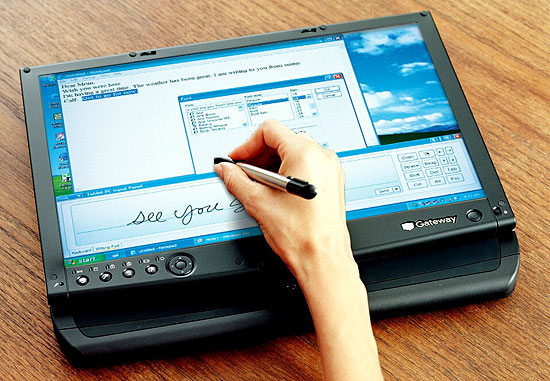
Gateway's new CX2600 notebook family, starting at $1,349, has a 14-inch wide screen that swivels around on a titanium frame. The 6-pound tablet comes with a flash card reader, wireless networking and slots for batteries that last for up to nine hours.

Credit: Gateway


Think tablet PCs are too expensive? Prices for Hewlett-Packard' s Compaq tc4200, which was first released in February 2005, start at $1,599, which is $44 less than a similarly outfitted Compaq nc4200 notebook.

Credit: Hewlett-Packard


Lenovo's X41T tablet is the first ThinkPad with a screen that swivels around to make a tablet PC. Retailing for $1,899, the tablet is Lenovo's first offering following its purchase of IBM's PC business earlier this year.

Credit: Lenovo


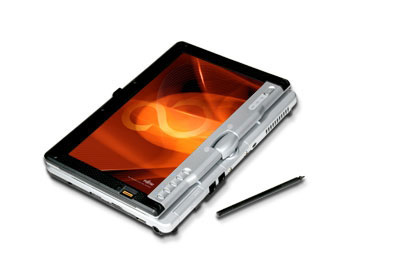
At just 2.2 pounds, the Fujitsu Siemens P1510 LifeBook convertible manages to squeeze in an 8.9-inch wide screen, 1.2GHz processor, 60GB hard drive, 1GB of RAM, Wi-If and Blue tooth. The notebook was released on Aug. 8 and retails for $1,499.

Credit: Fujitsu


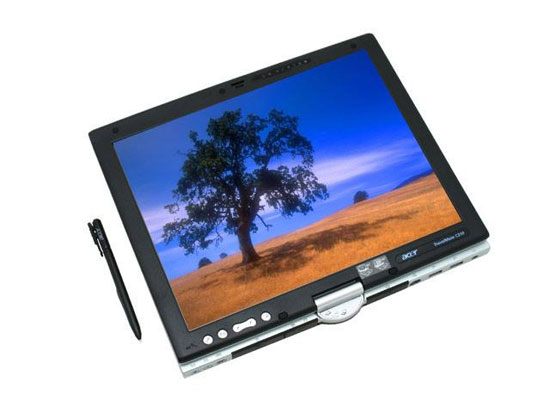
Acer was one of the first computer companies to make a tablet PC. Its fourth-generation TravelMat--the C310--retails for $1,649.99 and features a 14-inch screen, an Intel Pentium M processor, 8.5 hours of battery life (when the battery extender is used) and a two-spindle convertible tablet design.

Credit: Acer


Convertibles may be the new fashion trend, but slate tablets have some sizzle too. Motion Computing's LE1600 is used by hospitals and insurance agents. The tablet retails for $2,049 and comes with a 1.5GHz Intel processor, 512MB of RAM and a 30GB hard drive.

Credit: Motion Computing

Monday, October 30, 2006

Immense knowledge
Google

auctionads